
Just Because I Can See You Doesn’t Mean I Can See What You See
International Day for Tolerance: Understanding the Invisible Challenges of Vision Loss
November 16, 2026 International Day for Tolerance
Presented by the International Vision Institute (IVI)
What Does Tolerance Have to Do With Eyesight?
When we hear the word tolerance, we often think about respecting differences in culture, religion, beliefs, or backgrounds. But there’s another kind of difference that deserves our understanding — one that often goes unnoticed.
The way people see the world.
Not everyone sees what you see. And just because someone can look directly at you, recognize your face, or walk into a room without assistance doesn’t mean they have normal vision.
November 16, International Day for Tolerance, provides an opportunity to talk about something that doesn’t receive nearly enough attention: the misunderstanding, assumptions, and sometimes outright discrimination experienced by people living with vision impairments.
For millions of people, vision loss isn’t immediately obvious. There may be no white cane, no guide dog, no dark glasses, and no outward indication that anything is wrong.
Yet their daily experiences may be profoundly different from yours.
At the International Vision Institute, we believe that understanding is the first step toward inclusion. And when it comes to eyesight, that understanding begins with recognizing that vision loss is not always something you can see.
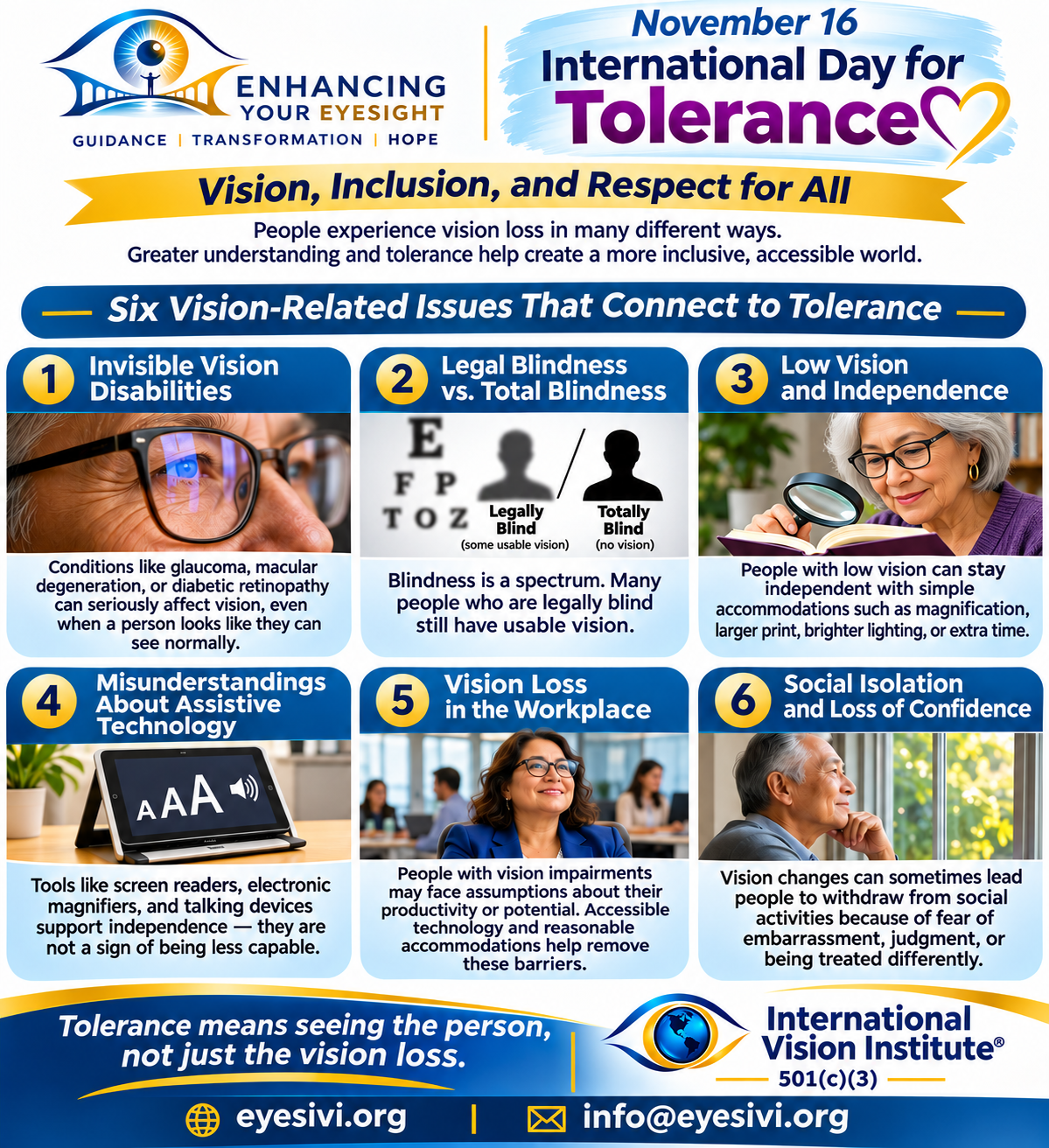
Let’s explore six important ways tolerance connects to eyesight, independence, and the everyday lives of people experiencing vision changes.
1. Invisible Vision Disabilities: You Don’t Have to Look Blind to Have Vision Loss
Imagine standing in a grocery store, looking directly at a shelf of products, but struggling to locate the one you need.
Someone standing beside you might wonder why you’re taking so long.
Perhaps you’re experiencing central vision loss from macular degeneration. Maybe glaucoma has affected your peripheral vision, making it difficult to locate objects outside your remaining field of view. Or diabetic retinopathy has caused areas of blurred or missing vision.
To someone watching, you may appear perfectly capable of seeing.
And in many ways, you are.
You might recognize familiar faces, read certain signs, or navigate your own home without difficulty. Yet other visual tasks may be challenging or impossible.
This is one of the most misunderstood aspects of vision loss.
People often assume that eyesight is either good or bad, that someone can see or cannot see. In reality, eyesight clarity is more like a variable light switching from bright light to darkness.
But eyesight is much more complicated.
Vision involves more than reading letters on an eye chart. It includes peripheral awareness, contrast sensitivity, depth perception, light adaptation, and the ability to distinguish details.
A person may read relatively well but struggle to navigate a crowded sidewalk. Another may walk confidently through a room but be unable to recognize someone’s face.
Tolerance begins when we stop judging someone’s visual abilities by their appearance.
Instead of asking, “How can you be visually impaired when you can see that?” we might ask, “Is there something I can do to make this easier?”
That small change in perspective can make an enormous difference.
2. Legal Blindness Versus Total Blindness: Understanding the Spectrum
One of the most common misconceptions about blindness is that it means living in complete darkness. It doesn’t.
Many people who are legally blind still have usable vision. Very blurry, and usable!
In the United States, legal blindness is generally defined by best-corrected visual acuity of 20/200 or worse in the better-seeing eye, or a visual field restricted to 20 degrees or less under applicable criteria.
But those numbers don’t tell the whole story.
Someone with 20/200 vision may still recognize large objects, distinguish colors, or navigate familiar environments.
A person with severe peripheral vision loss may have relatively sharp central vision but struggle with mobility and awareness of their surroundings.
And someone with advanced macular degeneration may have difficulty recognizing faces or reading while retaining enough peripheral vision to move around independently.
Total blindness, meaning no light perception, represents a different experience.
Yet society frequently places everyone under the same label: blind.
The American Foundation for the Blind has long emphasized the importance of recognizing that blindness encompasses a wide range of visual experiences.
This distinction matters.
When we assume that someone who is legally blind cannot see anything, we may unintentionally limit their opportunities or underestimate their capabilities.
On the other hand, when we see someone using their remaining vision, we may question whether they truly have a disability.
Both assumptions can be harmful.
Tolerance means understanding that two people with the same diagnosis—or even the same visual acuity—may experience the world very differently.
3. Low Vision and Independence: Needing Assistance Doesn’t Mean Losing Ability
Consider a woman who has always loved reading.
As her vision changes, the print in her favorite books becomes increasingly difficult to see.
Does that mean she must give up reading?
Absolutely not.
Perhaps she begins using a handheld magnifier. Maybe she discovers a ‘digital’ magnification device that enlarges text and adjusts contrast. Or she learns to listen to audiobooks while following along with enlarged print.
The activity may change, but the enjoyment doesn’t have to disappear.
This is where understanding and tolerance become especially important.
People with low vision often encounter well-meaning individuals who automatically take over tasks.
A family member might say, “Here, let me do that for you.”
A store employee may speak to a companion rather than directly to the person with the visual impairment.
A friend may stop extending invitations because they assume participating would be too difficult.
These actions may come from concern rather than disrespect, but they can gradually undermine someone’s sense of independence.
The truth is that many people with low vision can continue doing the activities they love when given appropriate tools, accommodations, and opportunities.
Larger print, better lighting, magnification, improved contrast, and additional time can make a meaningful difference.
Some individuals may benefit from orientation and mobility training, rehabilitation services, or adjustments to their living environment.
And sometimes, the most valuable accommodation is simply patience.
Independence doesn’t mean doing everything without assistance. It means having choices and maintaining control over your own life.
Before stepping in, ask.
Before assuming someone cannot participate, explore what would make participation possible.
And before taking something away in the name of helping, consider whether you’re also taking away an opportunity for independence.
4. Misunderstanding Assistive Technology: Tools That Open Doors
Think about how much technology you use every day.
You may rely on GPS navigation, voice commands, reading glasses, or your phone’s ability to enlarge text.
Most of us don’t consider these tools evidence of diminished ability.
We consider them convenient.
So why should assistive technology for someone with vision loss be viewed any differently?
Today, people with visual impairments have access to remarkable tools.
Screen readers can convert digital text into speech. Electronic or digital magnifiers can enlarge printed materials and enhance contrast. Smartphones can identify objects, read labels aloud, and help users navigate unfamiliar environments.
Refreshable braille displays provide access to digital information through touch.
Accessible software can help individuals manage finances, communicate, pursue education, and continue working.
Yet misunderstandings persist.
Someone using a talking computer may be perceived as less technologically capable.
A person using an electronic/digital magnifier may be treated as though they cannot read.
An employee who requests accessible software may be viewed as requiring special treatment rather than appropriate access to the tools needed to perform their job.
We need to change that thinking.
Assistive technology is not about what someone cannot do.
It’s about creating opportunities for what they can do.
Just as eyeglasses improve visual access for millions of people, assistive technology helps individuals use their remaining vision—or alternative methods of accessing information—to accomplish everyday tasks.
And here’s something worth remembering: accessibility often benefits everyone.
Voice technology, adjustable text sizes, improved contrast, and audio navigation are useful to people with and without disabilities.
When we make technology more accessible, we make the world easier to navigate for all of us.
5. Vision Loss in the Workplace: Ability Shouldn’t Be Judged by Eyesight
Imagine being an experienced professional with decades of knowledge, excellent communication skills, and a strong record of accomplishment.
Now imagine your eyesight begins to change.
Perhaps you develop glaucoma, diabetic eye disease, or macular degeneration.
You may still be fully capable of performing your job, but certain tasks become more challenging.
Reading small print on a computer screen may require magnification. Bright overhead lighting may create glare. Printed documents may need to be provided electronically.
These challenges don’t erase your experience, intelligence, or professional value.
Yet people experiencing vision loss may worry about disclosing their condition to an employer.
Will colleagues question their competence?
Will they be overlooked for promotions?
Will their employer assume they can no longer handle their responsibilities?
Unfortunately, misconceptions about visual disability can create barriers that have little to do with actual job performance.
In many workplaces, reasonable accommodations can make a substantial difference.
These may include larger monitors, screen magnification software, screen readers, adjustable lighting, accessible documents, or changes to how information is presented.
Under the Americans with Disabilities Act, qualified employees with disabilities may be entitled to reasonable accommodations, subject to applicable legal requirements and limitations.
But creating a truly inclusive workplace involves more than meeting legal obligations.
It requires a culture of understanding.
Managers need to recognize that employees may hesitate to disclose vision changes because they fear being treated differently.
Coworkers need to understand that using adaptive tools doesn’t make someone less productive.
And organizations need to recognize that experienced employees bring knowledge and perspectives that should not be discarded because their eyesight changes.
A person’s vision may change. Their value doesn’t.
On International Day for Tolerance, employers have an opportunity to ask an important question:
Are we evaluating people based on their abilities and contributions, or are we allowing assumptions about disability to influence our decisions?
6. Social Isolation and Loss of Confidence: The Emotional Side of Vision Loss
Vision loss doesn’t affect only what a person sees.
It can affect how they feel about themselves, their relationships, and their place in the world.
Imagine someone who has always been independent.
They drive, shop, visit friends, attend community events, and enjoy hobbies.
Then their eyesight begins to deteriorate.
Driving at night becomes uncomfortable. Reading restaurant menus becomes frustrating. Recognizing people across a room becomes difficult.
Perhaps they accidentally walk past a friend without saying hello.
The friend assumes they’re being unfriendly.
Perhaps they decline an invitation because they’re worried about navigating an unfamiliar location.
Others interpret their absence as a lack of interest.
Over time, these small experiences can accumulate.
Some people begin withdrawing from activities they once enjoyed.
They may feel embarrassed about asking for assistance or worry about becoming a burden.
Others experience anxiety, frustration, grief, or depression as they adjust to changes in their vision.
Not everyone responds to vision loss in the same way, and many people continue leading active, fulfilling lives.
But the emotional challenges deserve recognition.
This is where tolerance becomes more than a concept.
It becomes an action.
Invite the person who has stopped attending gatherings.
Ask what would make participation easier.
Offer transportation without making someone feel obligated or dependent.
Speak directly to the person rather than assuming a companion should answer for them.
And perhaps most importantly, listen.
Sometimes people experiencing vision loss don’t need someone to solve every problem.
They need someone who understands that their experience is real, respects their choices, and helps them discover what remains possible.
Connection, dignity, and independence are essential parts of quality of life.
No one should feel that changing eyesight means disappearing from the world around them.
From Tolerance to Understanding: What Can Each of Us Do?
International Day for Tolerance invites us to recognize human differences and respond with respect.
When it comes to eyesight, we can turn that principle into everyday actions.
Don’t assume. Someone’s appearance doesn’t tell you how well they see.
Ask before helping. Assistance is most meaningful when it respects the person’s preferences.
Speak directly to the individual. Vision impairment doesn’t diminish intelligence, personality, or the ability to make decisions.
Be patient. Some tasks may take longer, especially in unfamiliar environments.
Make information accessible. Consider larger print, readable fonts, strong contrast, and digital formats compatible with assistive technology.
Include rather than exclude. Instead of assuming someone cannot participate, ask what adjustments would make participation possible.
Recognize the person, not just the diagnosis. Everyone brings a lifetime of experiences, interests, talents, and relationships that extend far beyond their eyesight.
These actions don’t require specialized medical knowledge.
They require awareness, respect, and a willingness to see beyond our assumptions.
Just Because I Can See You Doesn’t Mean I Can See What You See
This simple statement captures one of the most important lessons about vision loss.
We often believe that seeing is a shared experience.
But the world you see may be very different from the world experienced by someone standing beside you.
You may notice a face that another person cannot recognize.
You may see a step that someone with reduced contrast sensitivity struggles to distinguish.
You may read a sign that is completely inaccessible to someone with central vision loss.
And you may never realize that the person beside you is navigating those challenges.
That’s why understanding matters.
Not because people with vision loss need sympathy, but because they deserve the same respect, opportunities, choices, and independence as everyone else.
Tolerance should never mean merely putting up with someone who is different.
It should mean recognizing those differences without allowing them to diminish someone’s dignity or place in society.
The International Vision Institute: Guidance, Transformation, and Hope
At the International Vision Institute, our mission is to empower people experiencing vision changes and vision loss through education, resources, support, and advocacy.
We believe that a diagnosis should not be the end of someone’s story.
It should be the beginning of understanding what comes next.
Whether someone is newly diagnosed with macular degeneration, adjusting to glaucoma, managing diabetic eye disease, or helping a family member navigate low vision, access to information and meaningful connections can make a tremendous difference.
Our role is to help bridge the gap between a medical diagnosis and everyday living.
That means helping people understand their options, discover useful technology, connect with appropriate resources, and maintain as much independence as possible.
It also means educating families, employers, communities, and the general public.
Because creating a more accessible world isn’t solely the responsibility of people living with disabilities.
It’s a responsibility we share.
A Final Thought for November 16
On this International Day for Tolerance, consider the people you encounter every day.
The person who takes longer to read a menu.
The employee who enlarges everything on their computer.
The neighbor who no longer drives at night.
The friend who doesn’t recognize you until you speak.
The individual who uses a magnifier, a white cane, a screen reader, or simply asks for a little more light.
Before making assumptions, remember:
Just because I can see you doesn’t mean I can see what you see.
And just because someone sees differently doesn’t mean they are any less capable, valuable, or deserving of respect.
Tolerance means seeing the person, not just the vision loss.
International Vision Institute (IVI)
A 501(c)(3) nonprofit organization
Enhancing Your Eyesight
Guidance | Transformation | Hope
Website: eyesivi.org
Email: info@eyesivi.org
Helping people protect their eyesight, navigate vision loss, and maintain independence through education, resources, and support.
Written by Katie L Friedman, LDO with assistance from ChatGPT